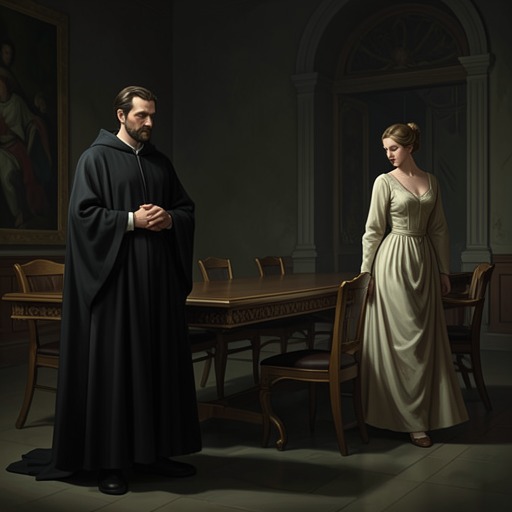
Septon Moon
Fire & BloodSepton Moon rose from the ranks of the Poor Fellows to become a rival religious leader whose following threatened both Oldtown and the peaceful transfer of power after King Maegor’s death. His influence rested on fervent preaching, the devotion of a large and unruly host, and the reluctance of nearby lords to confront him. His murder ended his campaign, but not the uncertainty surrounding who had arranged it.
Identity and Rise
The evidence offers no secure account of Septon Moon’s origins, and even his status as a septon is treated with doubt. The Poor Fellows proclaimed him the true High Septon, in opposition to the established officeholder in Oldtown, whom they derided as the High Lickspittle. He became one of the movement’s leading figures after the Faith Militant had been outlawed and its members driven from open battle into scattered resistance.
That resistance included the Poor Fellows’ attacks on royal loyalists and the Warrior’s Sons’ actions under Ser Joffrey Doggett. Septon Moon represented a different kind of threat: he gathered crowds through public preaching, moving through the riverlands and the Reach and emerging from the woods to denounce the king. His authority was therefore both religious and political, even though his claim to religious office was contested.
Preaching and Following
Septon Moon’s sermons centered on sin and the alleged wrongdoing of House Targaryen. He presented himself as a sinner, a posture that sat uneasily beside the authority his followers attributed to him. The account depicts him as a man of immense appetite rather than disciplined piety, and stresses the gap between his conduct and his role as a religious champion. His followers nevertheless treated him as a prophet and credited him with powers that made him a source of hope and good fortune.
The movement gave those beliefs a public form. Some of Moon’s followers carried images and carved objects associated with him, which they believed could bring prosperity. The episode illustrates how his personal reputation became part of the movement’s devotional life: his followers did not merely gather to hear denunciations of the crown, but invested his person with extraordinary promise. The contrast between that reverence and the account’s portrait of his self-indulgence is central to the characterization of his leadership.
By the time King Maegor returned from campaigning with thousands of alleged enemies’ heads, popular resentment had spread beyond the surviving armed orders. Lords and smallfolk increasingly aided the king’s opponents, and Septon Moon could travel through the riverlands and the Reach while drawing large crowds. His following thus belonged to a broader resistance sustained not only by fighters but also by local protection and sympathy.
The Oldtown Encampment
After Maegor’s death, the question of Jaehaerys’s anointing made Septon Moon’s position an immediate political problem. Jaehaerys needed the High Septon to anoint him, but travel to Oldtown was not considered safe while Moon and his followers remained there. The news of Maegor’s death caused some of the host to disperse, yet most of a force numbering close to five thousand stayed. Moon continued to demand that the Targaryens be driven out and called on Lord Hightower to yield Oldtown to him.
The camp stood beneath Oldtown’s walls, with Lords Oakheart and Rowan and their armed retainers among its defenders. Lord Hightower kept the city gates closed to Moon’s followers but did not move promptly against them. His reluctance left the established High Septon effectively confined within the Starry Sept and prolonged the standoff. Although the lords’ protection helped sustain Moon’s position, their unwillingness to assault the city also made his followers suspicious of them.
In King’s Landing, Jaehaerys and his council considered using dragons or sending an army across the Reach. The king rejected an attack that risked mass slaughter, and Queen Alyssa forbade the proposed use of dragons. Lord Rogar was prepared to lead a force against Moon’s host, but acknowledged that victory would come at a cost. The crisis ended instead through an attack inside Moon’s own camp.
Murder and Collapse
A woman entered Septon Moon’s tent with a flagon of wine, presenting it as a gift in return for his help. After a short interval she fled the tent, and Moon emerged in pursuit, gravely wounded. He died in the camp. The woman disappeared, and the guards could not agree on what she looked like. The wine remaining in the flagon was later shared by four Poor Fellows, all of whom died; the account identifies the drink as poisoned. The precise sequence suggests an attempted poisoning followed by a fatal attack, but it does not establish who planned either act.
Moon’s death caused the host to disintegrate. Some followers had already begun leaving after Maegor’s death and Jaehaerys’s accession; now rival claimants emerged, and their supporters fought among themselves. Two would-be successors contested possession of Moon’s body. Lorcas the Learned, claiming a vision that Moon would deliver Oldtown even after death, took the corpse and mounted an attack on the city. Fewer than a hundred men joined him. The assault failed, Lorcas and many of his followers died, and Oldtown’s defenders took possession of Moon’s remains.
The failed attack was the last substantial effort to continue Moon’s campaign. Lords Rowan and Oakheart withdrew, and the remaining camp dispersed, with many of its members looting as they went. Fewer than four hundred remained of the original force of nearly five thousand before Lord Hightower finally rode out against the stragglers. Moon’s death had therefore not simply removed a leader: it exposed the divisions within a host whose unity had depended heavily on his presence.
Responsibility and Significance
The identity of Moon’s killer and the source of her orders remain unresolved. The account rejects the idea that she acted independently as implausible, but preserves several possible sponsors: Jaehaerys, his Hand Rogar Baratheon, or Queen Alyssa. The woman’s disappearance and the guards’ conflicting descriptions also led some to suspect the Faceless Men. Other scholars consider that explanation unlikely, reasoning that the conspicuous, violent nature of the killing did not fit their practice of making deaths appear natural.
A camp follower acting for Lord Rowan or Lord Oakheart is presented as the explanation many scholars favor. The lords’ rapid withdrawal after Moon’s death, followed by their return to Oldtown to submit to Jaehaerys at his coronation, supports the possibility that their grievance had been against Maegor rather than the Targaryen dynasty itself. It does not prove their involvement. Moon’s death remains both a decisive political turning point and an episode whose central agency cannot be established with certainty: the host broke apart, the immediate obstacle to Jaehaerys’s anointing was removed, and the identity of the power behind the killing passed into debate.